
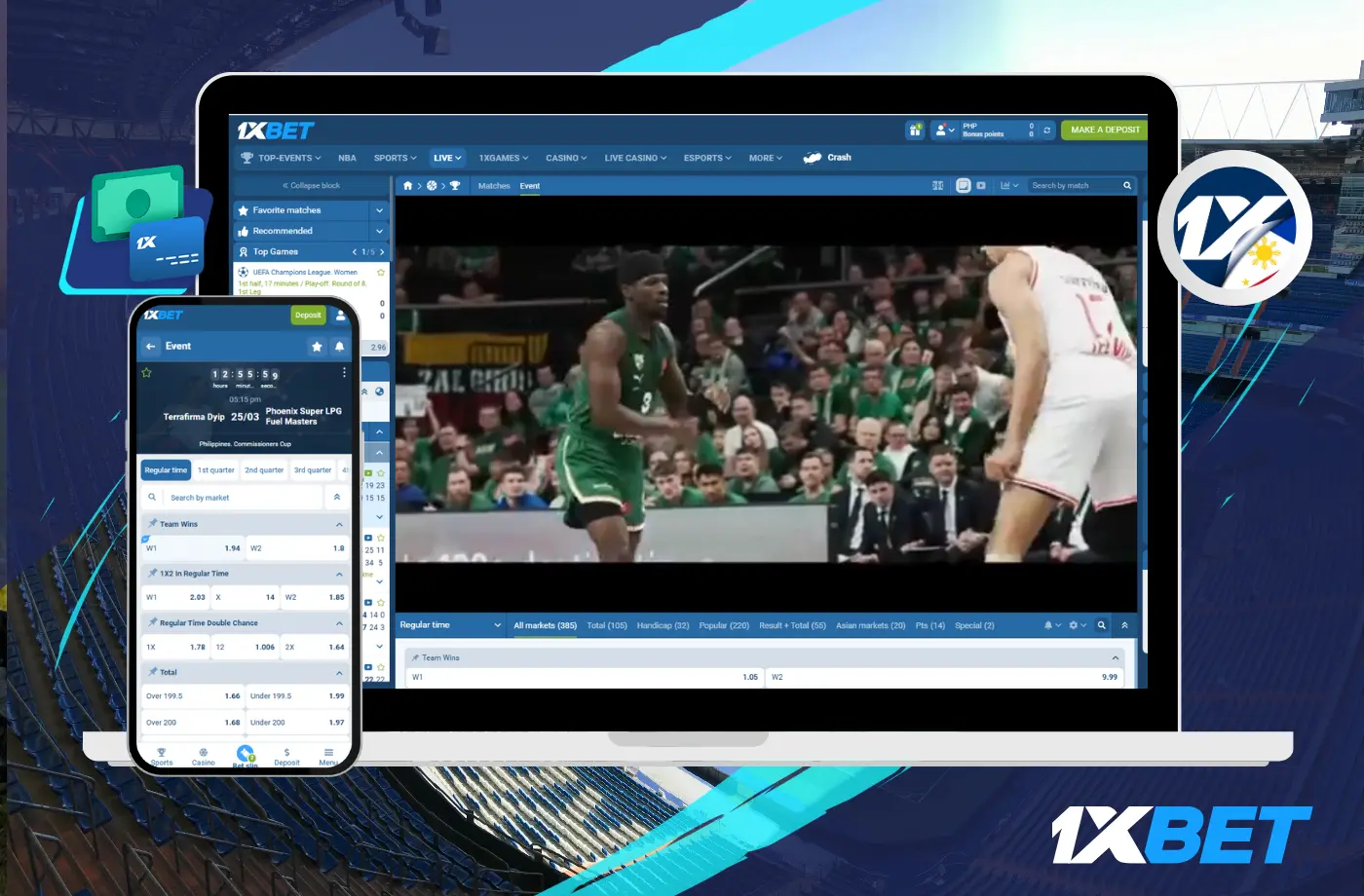
Basketball is not a 90-minute waiting game. It is a sport that generates a scorable betting event roughly every 20 seconds – which is precisely why 1xBet structures basketball markets around periods, milestones, and scoring sequences rather than just match results. Win by Halves, Win by Quarters, Correct Score by Quarters, and Race to N Points are four distinct market families that most football-first bettors have never encountered. They look unfamiliar. Once you understand the logic behind each one, they become some of the most readable markets on the platform.
This guide defines each market, explains the “neither” option that confuses nearly every first-time user, and walks through live examples from both PBA and NBA contexts.
Back to the 1xbet Betting Rules.
Win by Halves
Win by Halves asks a straightforward question: which team wins each half of the basketball game on points scored during that half alone?
The market splits the game into two independent scoring periods:
- First Half – Points scored in Q1 and Q2 combined
- Second Half – Points scored in Q3 and Q4 combined
Each half is treated as a self-contained contest. It doesn’t matter who leads overall – only the points scored within that specific half determine the result.
How the market is structured:
For each half, three outcomes are available in most 1xBet presentations:
| Selection | Meaning |
|---|---|
| Team 1 wins the half | More points scored in that half by the home/first-listed team |
| Team 2 wins the half | More points scored in that half by the away/second-listed team |
| Tie (half) | Both teams score an equal number of points in that half |
Some 1xBet Win by Halves presentations go further – offering a combined market that covers which team wins both halves, one half each, or specific half-win combinations. These are labeled as “Team to win both halves” or “Half-by-half outcome.”
| PBA example: Meralco Bolts vs TNT Tropang Giga. After Q1 and Q2, the score is Meralco 52 – TNT 48. Meralco wins the first half by 4 points. This settles as a Team 1 First Half Win regardless of the overall match result. |
Win by Quarters
Win by Quarters applies the same period-based logic as Win by Halves, but at the individual quarter level. Each quarter (Q1, Q2, Q3, Q4) is a separate market.
The market for each quarter presents:
| Selection | Meaning |
|---|---|
| Team 1 wins Q[n] | First-listed team scores more points in that quarter |
| Team 2 wins Q[n] | Second-listed team scores more points in that quarter |
| Tie in Q[n] | Both teams score equally in that quarter |
Quarter ties are uncommon but not rare – they occur in roughly 8–12% of NBA quarters depending on the season and matchup type. This is why the tie option carries meaningful odds rather than being a token selection.
Quarter markets vs Half markets – key difference:
Half markets aggregate two quarters of data. A team that wins Q1 narrowly and loses Q2 badly might still lose the first half overall. Quarter markets isolate just 12 minutes of play, making them more volatile and more reactive to lineup rotations, foul trouble, and momentum swings.
| NBA example: Golden State Warriors vs LA Lakers, Q3. The third quarter is a separate Win by Quarters market. If the Warriors outscore the Lakers 34–28 in Q3 specifically, the Q3 market settles as a Team 1 Win – regardless of whether the Warriors won or lost the overall game. |
Correct Score by Quarters
Correct Score by Quarters is a precision market. It asks not just who wins each quarter, but by exactly how many points.
The market presents a list of possible point-differential outcomes for a specific quarter. Common formats include:
- Team 1 by 1-5 points
- Team 1 by 6-10 points
- Team 1 by 11-15 points
- Team 1 by 16+ points
- Tie
- Team 2 by 1-5 points
- (and so on)
The selections cover ranges, not exact final scores. You’re backing how dominant the winning team will be in that quarter – not predicting the precise scoreline.
| Selection | Illustrative Odds |
|---|---|
| Team 1 wins Q2 | 1.75 |
| Team 1 wins Q2 by 6–10 points | 4.50 or higher |
| NBA example: Boston Celtics vs Miami Heat, Q4. The Celtics are known for strong fourth-quarter defensive intensity. If you back “Team 1 (Celtics) by 6–10 points in Q4” at 5.20 and the final Q4 score is Celtics 32 – Heat 25 (a 7-point differential), the bet settles as a win. |
Where this market appears on 1xBet: Correct Score by Quarters is typically found under the Quarters or Period Markets tab within the event detail. It is available pre-match on major NBA and select PBA games, and occasionally in live betting depending on which quarter is active.
Race to N Points
Race to N Points is the most distinctive basketball market on 1xBet – and the one that generates the most beginner confusion. It doesn’t measure period results. It measures which team reaches a specific cumulative points total first during the game.
How it works:
The market sets a points threshold – typically 10, 15, 20, 25, 30, or higher. You back which team you expect to reach that total first in the game’s running score.
| Selection | Meaning |
|---|---|
| Team 1 | First-listed team reaches the threshold before Team 2 |
| Team 2 | Second-listed team reaches the threshold before Team 1 |
| Neither | Neither team reaches the threshold within the specified period |
“Neither” explained – the option everyone asks about:
“Neither” is not a draw. It means the threshold is not reached by either team within the defined window. This option exists because Race to N Points markets on 1xBet are frequently constrained to a specific period – most commonly the first half, or the entire game up to a set point in time.
| Example of “Neither” winning: Race to 30 Points – First Half. If both teams are playing defensively and the first-half score is 24–22 at the halftime buzzer, neither team reached 30 points in the first half. The “Neither” selection wins. |
Without understanding “Neither,” the market appears to only offer two team selections. It actually offers three – and “Neither” can be a genuinely competitive option in low-scoring matchups, defensive sets, or when the threshold is set high relative to typical first-half scoring.
| PBA example – Race to 20: San Miguel Beermen vs Magnolia Chicken Timplados, Race to 20 Points. San Miguel’s offense gets rolling early. They hit their 20th point with 4:15 left in Q1. Magnolia is at 14 at that moment. San Miguel wins the Race to 20 market – regardless of what happens for the rest of the game. |
Race to Points 2-Way
Race to Points 2-Way is a simplified version of the standard Race to N market. It removes the “Neither” option entirely, presenting only two selections:
| Selection | Meaning |
|---|---|
| Team 1 | Reaches the threshold before Team 2 |
| Team 2 | Reaches the threshold before Team 1 |
| Market Format | Threshold Level | “Neither” Option | Typical Application |
|---|---|---|---|
| Race to N Points (3-way) | Moderate to high relative to period | Yes | First-half or quarter-specific races |
| Race to Points 2-Way | Low relative to full-game scoring | No | Full-game race to an easily-reached total |
Odds comparison – 2-Way vs 3-Way:
Because “Neither” absorbs some probability in a three-way race market, the two team selections in a 3-way market carry slightly higher odds than the equivalent selections in a 2-Way market.
| Market | Illustrative Team 1 Odds |
|---|---|
| 3-way Race to 25 (first half) | 1.90 |
| 2-Way Race to 25 (full game) | 1.65 |
Live Examples Across Markets
PBA: Ginebra vs Meralco – Full Market Scenario
| Market | Selection | Scenario That Wins |
|---|---|---|
| Win by Halves – H1 | Ginebra | Ginebra outscores Meralco in Q1+Q2 combined |
| Win by Quarters – Q3 | Meralco | Meralco scores more than Ginebra in Q3 alone |
| Correct Score by Quarters – Q1 | Team 2 by 1-5 | Meralco wins Q1 by 1, 2, 3, 4, or 5 points |
| Race to 20 – Full Game | Neither | Neither team reaches 20 points first… (not applicable here – threshold too low; used for Race to 100) |
| Race to 10 – Full Game 2-Way | Ginebra | Ginebra reaches 10 points before Meralco |
Late in Q3, Warriors trail by 6 overall but have been strong in Q4 historically.
- Win by Quarters Q4 – Back Warriors to win Q4 independently of the match result
- Race to 30 – Q4 only – Back Warriors to reach 30 fourth-quarter points first
- Correct Score by Quarters Q4 – Back Warriors to win Q4 by 6–10 points
These three bets all express the same directional read – Warriors dominate Q4 – but through three different market structures, each with different odds and settlement conditions.